
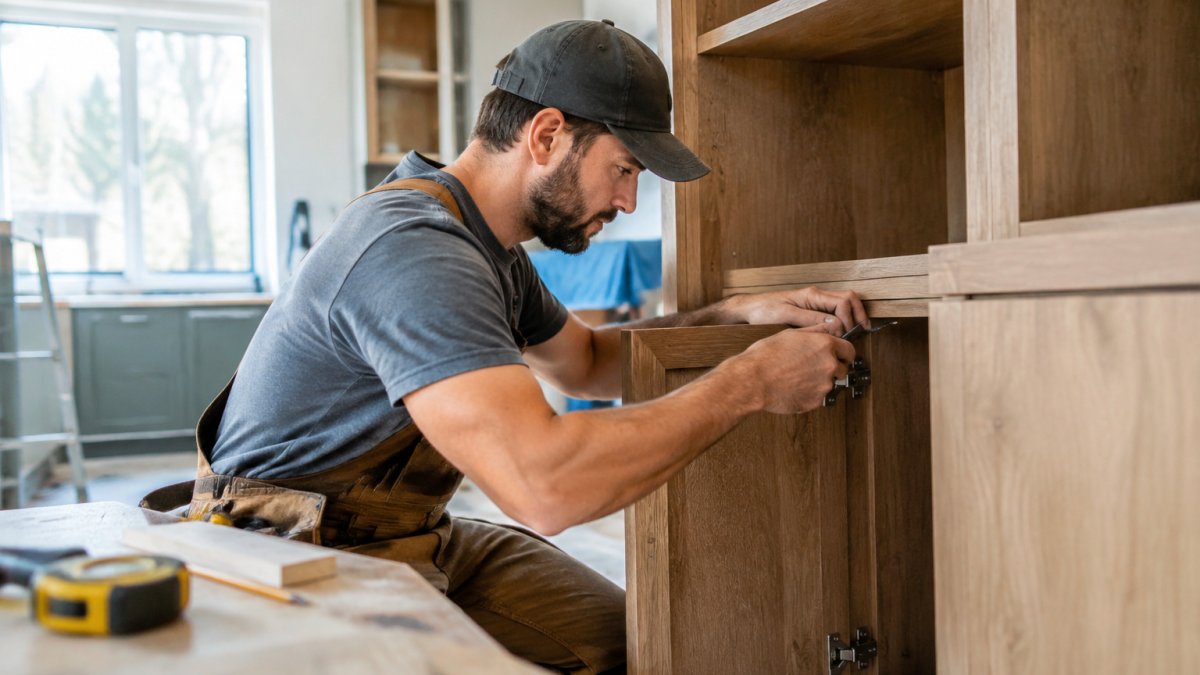
Last Updated: November 5, 2026
Quick Summary
Custom carpentry justifies a higher price because you pay for solid wood and quality plywood instead of particleboard, for slower hand-fitting that takes more hours than assembling flat-pack boxes, and for a design built to your room rather than a fixed stock size. The premium moves money from a warehouse shelf into your space.
- Solid wood and quality plywood cost more than particleboard and thin veneer.
- Skilled labor is the largest line in most custom bids and the hardest to fake.
- Custom cabinets are built to the room, so there are no filler strips or dead corners.
- Precise measurements matter most in older homes where walls, floors and ceilings are rarely square.
- Skip the premium for rentals, flips, standard spaces, tight budgets or when speed matters more than fit.
Table of Contents
- The Real Reasons Custom Carpentry Costs More
- Material Quality and Wood Selection Behind the Premium
- Skilled Labor, Craftsmanship, and Labor-Intensive Construction
- Custom Carpentry vs. Stock Cabinets: Fit, Finish, and Function
- Design Complexity, Precise Measurements, and Space Planning
- Your Custom Carpentry Estimate Checklist
- What a Realistic Custom Carpentry Project Timeline Looks Like
- When Custom Carpentry Is Not Worth the Premium
- Frequently Asked Questions
The Real Reasons Custom Carpentry Costs More
Custom carpentry justifies a higher price because you are paying for materials cut and fitted to your actual house, for skilled hands that take longer to do the work, and for a design built around your space instead of a box that almost fits. At Caledonian Customs, we build custom carpentry and built-ins on site, and the price gap comes down to three things: better wood, slower work, and a design made for one room only.
A stock cabinet leaves a factory in a standard size. A custom piece starts as raw lumber and ends as a wall that fits to the sixteenth of an inch.
That difference is real, and it costs money. Below, we break down exactly where your money goes, so you can judge whether the premium is worth it for your project.
Where the Money Goes: Materials, Labor, and Time
Three buckets hold almost all of the extra cost.
- Materials. Solid wood and quality plywood cost more than particleboard and thin veneer.
- Labor. Hand-fitting takes more hours than assembling a flat-pack box.
- Time. Custom work is built to order, so it takes longer from order to install.
Cost pressure across the trades is real right now. The National Association of Home Builders tariff analysis notes that more than 60% of surveyed builders reported higher costs tied to tariffs, and material prices feed straight into what a shop pays for lumber and hardware.
None of that is wasted money. It is money moved from a warehouse shelf into your room.
Material Quality and Wood Selection Behind the Premium
Wood quality is the first place a quote splits apart. Two bids can look identical on paper and use completely different cores.
Here is what actually changes the price:
- Solid wood for doors, frames, and face trim. It takes a finish, holds a screw, and can be sanded and refinished later.
- Quality plywood for cabinet boxes. It resists warping better than particleboard in humid rooms.
- Better hardware. Soft-close hinges and full-extension drawer slides cost more and last longer.
A cheap cabinet hides its core behind a photo of wood grain. A good one lets you see the edge.
Ask any builder to name the species and the sheet goods before you compare numbers. If they cannot answer, the price is not telling you much.
Skilled Labor, Craftsmanship, and Labor-Intensive Construction
Skilled labor is the largest line in most custom bids, and it is the hardest to fake. A union-trained carpenter measures twice, cuts once, and knows how a wall actually behaves after twenty years of settling.
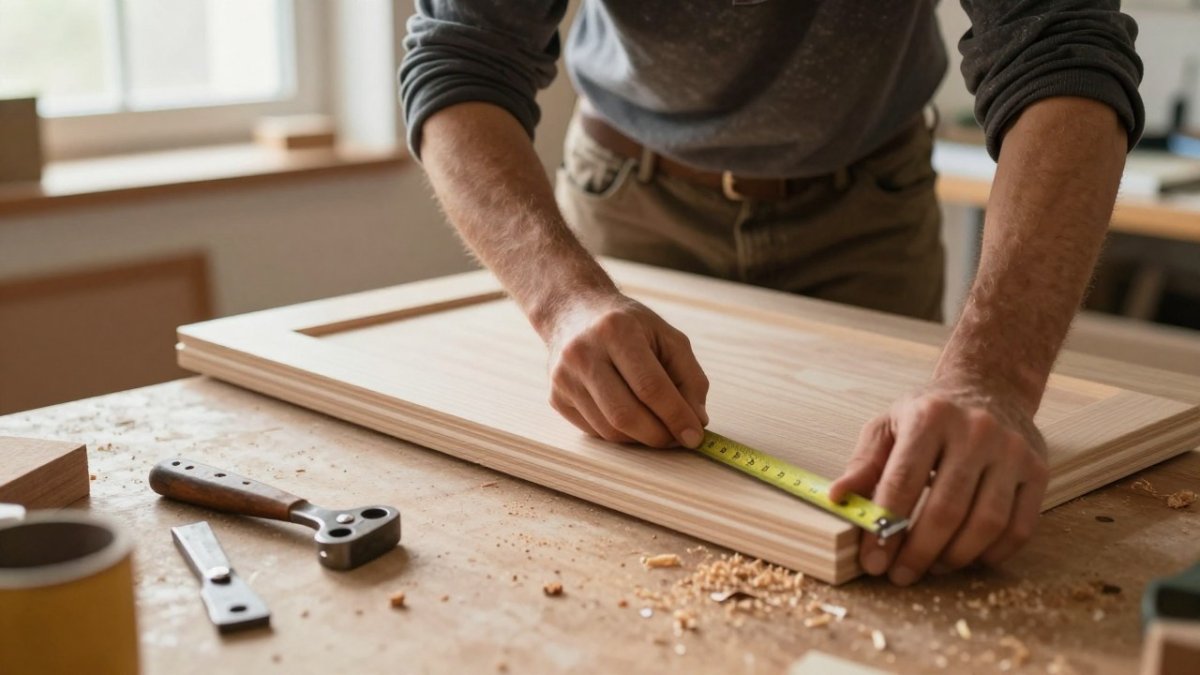
Custom joinery is slow on purpose. Dovetail drawers, fitted face frames, and hand-set trim all take time that a factory line does not spend.
We are an owner-led shop founded by a union-trained carpenter, so we plan and sequence the work before construction starts. That planning is part of what you pay for. You can see the labor intensity in a documented custom mudroom built-in built floor to ceiling on site.
Custom Carpentry vs. Stock Cabinets: Fit, Finish, and Function
Stock cabinets come in fixed widths. Semi-custom cabinets let you adjust a few dimensions. Custom cabinets are built to your room, which means no filler strips, no dead corners, and no compromise on where the drawers land.
That is the core of custom carpentry vs. stock cabinets: you trade speed and a lower sticker for a fit that looks built in because it is.
| Option | Fit to Your Space | Lead Time | Best For |
|---|---|---|---|
| Stock cabinets | Fixed sizes, filler strips | In stock, fast | Tight budgets, rental units |
| Semi-custom cabinets | A few size adjustments | Several weeks | Middle-ground remodels |
| Custom cabinetry | Built to the room | Longer, built to order | Odd spaces, long-term homes |
The finish tells the same story. Factory finishes are uniform. A hand-finished piece gets sanded between coats and matched to your existing trim.
If you want to see what site-built work looks like in a real house, our custom carpentry and built-ins service covers built-ins, wall treatments, stairs, and trim fitted to the existing structure.
Design Complexity, Precise Measurements, and Space Planning
Design complexity drives cost more than most homeowners expect. A straight run of base cabinets is simple. A window seat that wraps a corner, hides a radiator, and opens for storage is not.
Precise measurements matter most in older homes. Walls are rarely square, floors rarely level, and ceilings rarely flat. Custom work absorbs those flaws instead of highlighting them.
Good space planning turns dead square footage into usable storage. That is where custom built-in furniture earns its keep:
- A stair nook becomes a coat closet.
- A blank wall becomes floor-to-ceiling shelving.
- A cramped kitchen gains a pantry that fits the gap exactly.
A documented living room and stairs project shows a custom wall treatment and rebuilt built-ins fitted to an existing house, which is what tailored design looks like in practice.
Your Custom Carpentry Estimate Checklist
A good estimate is itemized, not a single lump sum, and the fastest way to compare bids is to put them side by side against the same scope. Use this checklist as a comparison tool, not just a list of questions.
Scope and drawings. Each bid should reference the same drawings or a written scope description. If one bid assumes a straight run and another includes a corner return, you are comparing different projects. Ask for a line-by-line scope statement and confirm the drawings match.
Materials by species and sheet good. Look for species names (oak, maple, poplar, walnut) and sheet-good thickness and core type (plywood versus particleboard). "Wood" is not a specification.
Hardware by brand and type. Soft-close hinges, full-extension slides, and drawer glides vary widely by brand and duty rating. A bid that names the hardware line is easier to compare than one that says "quality hardware."
Labor and fabrication separated from materials. Ask whether labor is billed hourly or by unit, and whether fabrication time is stated separately from install time. A bid that bundles everything into one number hides where the premium actually is.
Finishing specified. Confirm the number of coats, the product line, and whether finishing happens in a shop or on site. Site finishing can be slower and messier, and it affects the schedule.
Installation and site protection. Confirm that protection, demolition, cleanup, and haul-away are included. On older homes, ask whether the bid assumes unlevel floors and out-of-square walls or whether those conditions trigger change orders.
Exclusions and allowances. Every bid has exclusions. Look for what is not included: appliances, tile, paint, permits, structural work, or electrical. Allowances for hardware or finishes should be stated as dollar amounts so you can compare them.
Change-order process in writing. A written change-order process with hourly rates or unit pricing protects both sides. A verbal "we'll work it out" is how budgets slip.
Payment schedule tied to milestones. Payments should be tied to completed milestones, not calendar dates. A schedule that front-loads payment leaves you with little leverage if the work stalls.
Warranty terms spelled out. Ask what is covered, for how long, and whether the warranty covers labor as well as materials. A one-year workmanship warranty is common; longer terms vary by shop.
Permit responsibility stated clearly. Confirm who pulls permits and who is responsible for inspections. This is a common source of delay and cost overruns.
Start and finish dates with a buffer. Custom work runs on a longer clock than stock. Ask for a start date, a finish date, and a buffer for material availability.
If a bid is one number on one page, ask for the breakdown. For a sense of what drives price on a bigger project, our kitchen remodel cost breakdown for Overland Park walks through scope, size, and finishes.
What a Realistic Custom Carpentry Project Timeline Looks Like
Custom work runs on a longer clock than stock.
The timeline usually looks like this:
- Design and measuring. Drawings, material picks, and a firm quote.
- Fabrication. The shop builds the pieces to order.
- Site prep. Protection, demolition, and any structural work.
- Installation. Fitting, trim, and hardware.
- Finishing. Paint or stain, touch-ups, and final walkthrough.
Watch out: ordering appliances or tile late can stall the whole sequence. Lock in long-lead items before fabrication begins.
We plan and sequence each project before construction starts, which keeps trades from stepping on each other.
When Custom Carpentry Is Not Worth the Premium
Custom is not always the right call, and we will tell you so. Custom work can cost significantly more than prefab and often takes longer, according to Willard Woodworks on custom versus prefab carpentry, because of the extra labor and materials involved.
Skip the premium when:
- You are remodeling a rental or a short-term flip.
- The space is standard and stock sizes fit cleanly.
- Speed matters more than fit.
- The budget is fixed and tight.
In those cases, semi-custom or quality stock cabinets do the job. Custom earns its price when the room is unusual, the home is a long-term hold, and you care about fit and finish you will see every day.
If you are weighing the decision, tell us what you're planning and we will give you a straight answer, including when a simpler option makes more sense.
Frequently Asked Questions
Why does custom carpentry cost more than standard carpentry?
The gap comes from three places. Custom work uses premium materials such as solid wood instead of particleboard, and it is labor-intensive: each piece is measured, fabricated, and finished for one specific space rather than pulled from a catalog. Design complexity and unique specifications add fabrication time. You are paying for fit, durability, and a piece built to your room.
How does custom carpentry compare with stock cabinets or shelving?
Stock cabinets come in fixed sizes, so installers fill gaps with filler strips and panels. That is faster and cheaper upfront, but the fit and finish show it. Custom cabinetry is built to precise measurements, so awkward corners, sloped ceilings, and odd wall lengths get used instead of blocked off. Custom carpentry vs. stock cabinets also differs on construction: solid wood and durable joinery versus engineered panels. Stock wins on speed and upfront cost; custom wins on storage efficiency, longevity, and resale appeal.
What should a custom carpentry estimate include?
A usable estimate itemizes materials by type and grade, labor hours, hardware, finishing, fabrication time, installation, and any structural work. It should name the wood species and panel construction, state who handles permits and trade coordination, and spell out the payment schedule and change-order process. Ask whether demolition, disposal, and paint or stain are included. Use a custom carpentry estimate checklist to compare quotes line by line rather than on the bottom number alone, because a low bid often omits finishing or hardware.
How long does custom carpentry take, and is it worth the wait?
Fabrication and installation timelines depend on the scope of the project and are confirmed in your written schedule. A custom carpentry project timeline also includes design, material ordering, and sequencing with other trades. The wait buys precise measurements, tailored design, and a fit that stock options cannot match. If your schedule is tight or the space is standard, semi-custom or stock may serve you better. Ask for a written schedule with milestones before you sign.
The premium for custom carpentry is not a markup for a name. It is the cost of better wood, slower hands, and a design built for one room. If that trade fits your project, Caledonian Customs can walk you through it. We are owner-led, union-trained, and we handle planning through final walkthrough with in-house custom carpentry and built-ins, coordinated trade partners, and finish work we stand behind. Get started with Caledonian Customs and request a consultation for your project.
