
blog
7 Kitchen Cabinet Pull-Out Shelf Options That Actually Work
Last Updated: November 4, 2026
Quick Summary
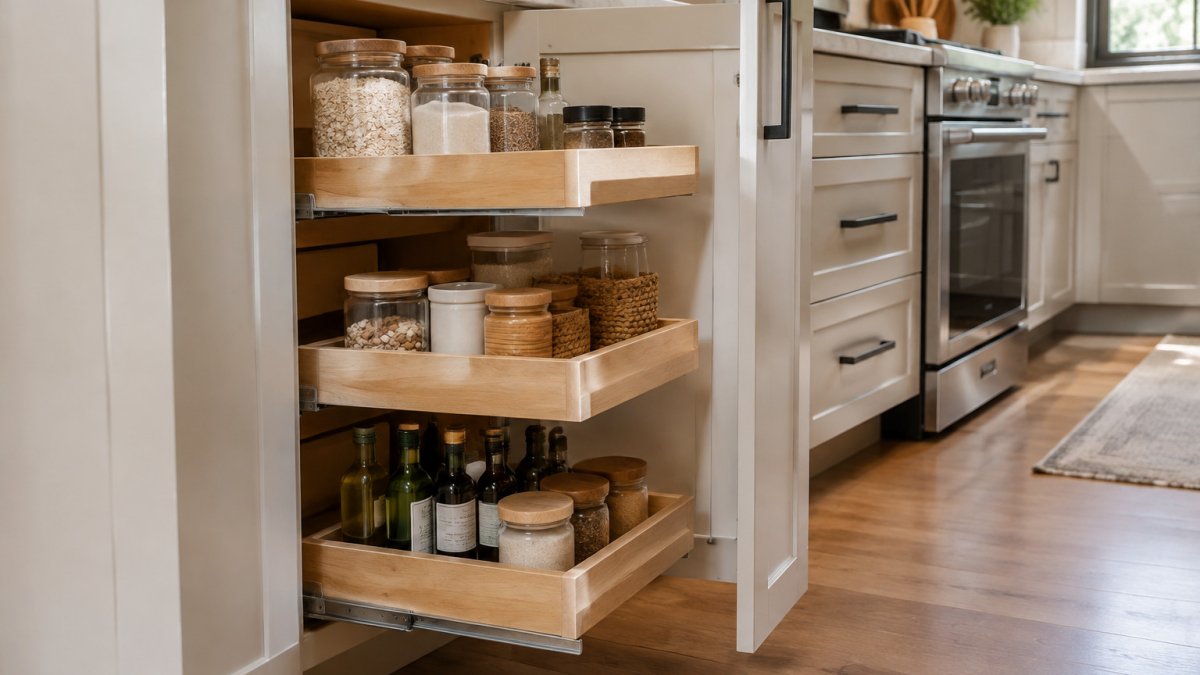
Pull-out shelves are sliding platforms mounted inside a cabinet that bring stored items forward to the door opening, so you can see and reach everything instead of kneeling and reaching into darkness. They work best in deep base cabinets, blind corners, and pantry cabinets, and full-extension slides are the key specification in cabinets 24 inches deep.
- A standard base cabinet is roughly 24 inches deep, but your arm reaches comfortably to about 18 inches.
- Pull-outs are less useful in narrow cabinets under 12 inches wide, where the slide mechanism eats too much of the opening.
- Measure interior width at the front, middle, and back of the cabinet box and use the smallest number.
- Slides fail before shelves do, with slide bearings and mounting screws pulling out of thin cabinet floors as common failure points.
- Pull-outs don't add storage capacity, they add access, and they are cheapest to add during a remodel.
Table of Contents
- Why Pull-Out Shelves Change How You Use Kitchen Cabinets
- The Best Pull Out Shelves for Kitchen Cabinets by Configuration
- Custom Pull Out Shelves for Kitchen Cabinets: What Made-to-Fit Gets You
- Pull Out Shelves for Deep Cabinets: Solving the Back-of-Cabinet Problem
- Kitchen Cabinet Pull Out Shelves Corner Solutions That Beat a Blind Reach
- How to Measure, Fit, and Install Pull-Out Shelves in Existing Cabinets
- Planning Pull-Out Shelves Into Your Kitchen Remodel
- Frequently Asked Questions
Why Pull-Out Shelves Change How You Use Kitchen Cabinets
Kitchen cabinets with pull out shelves solve a problem most homeowners accept as normal: the back of a base cabinet is a storage dead zone.
Pull-out shelves are sliding platforms mounted inside a cabinet that bring stored items forward to the door opening.
The popularity is real. A kitchen storage trends report from Würth Louis and Company lists pull-out shelves as a leading storage feature in current kitchen design.
The Reach Problem in Standard Base Cabinets
A standard base cabinet is roughly 24 inches deep. Your arm reaches comfortably to about 18 inches. That leaves a six-inch strip at the back where things go to die.
Adjustable shelves make it worse. The shelf height is fixed by pin holes, so tall items force you to leave gaps above them. Those gaps become clutter zones.
Where Pull-Outs Help Most and Where They Don't
Pull-outs shine in deep base cabinets, blind corners, and pantry cabinets where food gets buried. They're less useful in narrow cabinets under 12 inches wide, where the slide mechanism eats too much of the opening. Pull-out hardware can consume space a narrow cabinet needs, which is why fit checks matter more than enthusiasm.
One documented project shows how access fits a larger plan: John's Kitchen & Structural Remodel opened two load-bearing walls before reconfiguring the kitchen entirely.
The Best Pull Out Shelves for Kitchen Cabinets by Configuration
The best pull out shelves for kitchen cabinets depend on cabinet width, depth, slide type, and what you store. Measure the opening, pick the configuration, then pick the slide. Here is how the four common configurations differ.
| Configuration | Typical cabinet width | Best for | Space lost | Slide type to ask for | Relative cost |
|---|---|---|---|---|---|
| Single slide-out shelf | 12-36 in. | One heavy item, appliance storage | Low | Full-extension, side-mount or undermount | Lowest |
| Two-shelf combo | 15-36 in. | General base cabinet storage | Moderate (roughly 2-3 in. of height per shelf) | Full-extension, undermount preferred | Mid |
| Triple-stack unit | 12-24 in. | Pantry cabinets, cans, boxed goods | Highest (each shelf needs clearance) | Full-extension, side-mount common | Highest |
| Appliance lift | 24-36 in. | Stand mixer, food processor, heavy countertop appliances | High (mechanism occupies the lower box) | Spring-assisted or motorized lift | Highest |
Single Slides, Two-Shelf Combos, and Triple-Stack Units
Two-shelf combos are the workhorse for base cabinets. The lower shelf carries pots, the upper shelf carries lids and smaller items.
Triple-stack units belong in pantry cabinets. Three shallow shelves let you see every can and box without stacking.
Appliance lifts bring a heavy mixer up to counter height, so you are not lifting it out of a low cabinet.
How to Choose Between Configurations
Work through these questions in order:
- What is the cabinet width? Under 12 inches, the slide mechanism eats too much of the opening; a fixed shelf or a narrow single slide is usually the better call.
- What are you storing? Heavy appliances point to a single slide or lift. Cans and boxed goods point to a triple-stack. Mixed pots and lids point to a two-shelf combo.
- How deep is the cabinet? Anything 24 inches deep needs full-extension slides, or the back third stays unreachable.
- Who is reaching into it? A lift or a low single shelf serves limited mobility better than a stacked unit that requires bending and lifting.
Watch out: a triple-stack in a 24-inch-deep pantry looks efficient on paper but can leave no shelf tall enough for cereal or oil bottles. Measure your tallest recurring item before you choose the stack count.
Custom Pull Out Shelves for Kitchen Cabinets: What Made-to-Fit Gets You
Custom pull out shelves for kitchen cabinets are built to the exact cabinet opening rather than bought in standard widths.
Made-to-fit matters most in three situations: non-standard cabinet widths, framed cabinets with a face frame that narrows the opening, and older cabinets where the box isn't perfectly square. Stock units assume square boxes and standard openings. Older homes rarely deliver either.
What most guides miss is the mounting question. A pull-out shelf screws into the cabinet floor and side walls. In a frameless cabinet, that's straightforward.
For homeowners considering site-built work, custom carpentry and built-ins covers how made-to-fit pieces are fabricated and installed.
Pull Out Shelves for Deep Cabinets: Solving the Back-of-Cabinet Problem
Pull out shelves for deep cabinets are the single highest-value upgrade in the category. A 24-inch-deep base cabinet with a standard shelf hides its back third.
The key specification is slide extension. Standard slides extend about three-quarters of the way. Full-extension slides come all the way out, which is what you need in a deep cabinet.
Load capacity matters here too. A deep shelf loaded with canned goods gets heavy fast.
Kitchen Cabinet Pull Out Shelves Corner Solutions That Beat a Blind Reach
Kitchen cabinet pull out shelves corner solutions replace the blind reach into a dark corner with a shelf that comes to you.
The rotating shelf wins on simplicity. It uses the corner's full depth and has no complex mechanism to fail.
Watch out: corner pull-outs have more moving parts than any other configuration, and cheap pivoting hardware is where failures show up first.
How to Measure, Fit, and Install Pull-Out Shelves in Existing Cabinets
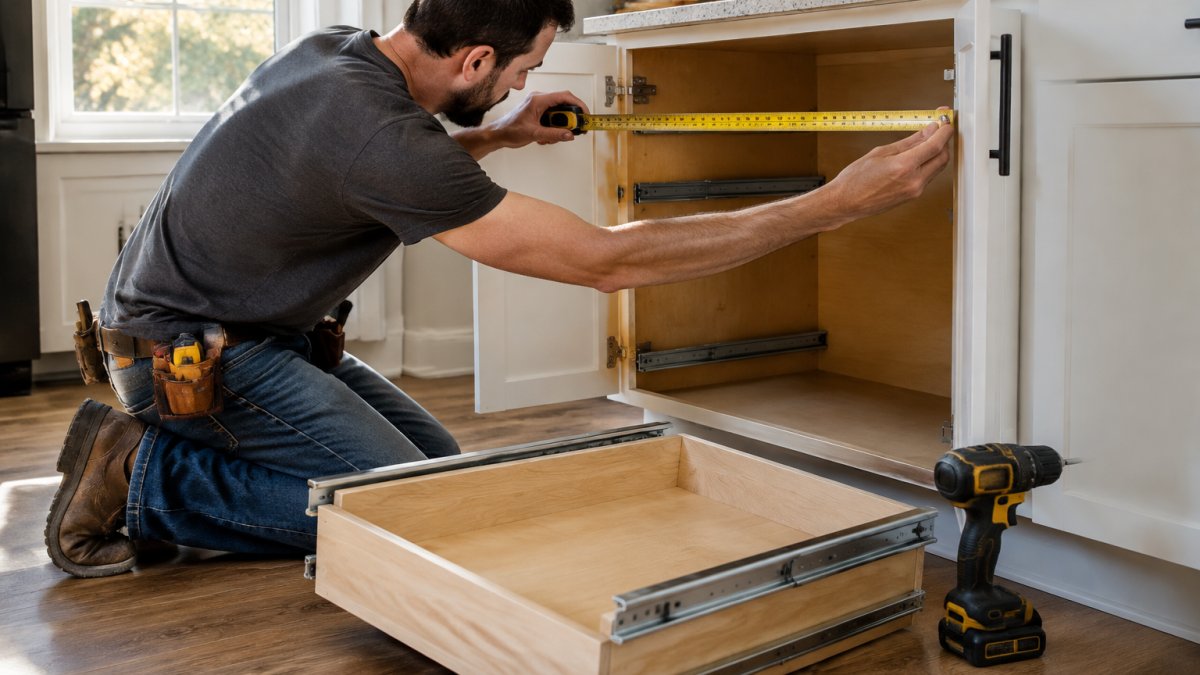
Measuring correctly is the whole job. Get these four numbers before you order anything:
- Interior width at the front, middle, and back of the cabinet box
- Interior depth from the back wall to the inside of the door
- Interior height from the cabinet floor to the lowest obstruction
Measuring the Cabinet Opening and Checking for Obstructions
Measure width in three places because cabinet boxes bow. Use the smallest number. Then check for obstructions: hinges, a center stile, plumbing, or a drawer above that limits height.
For framed cabinets, measure inside the face frame opening, not the box. The frame narrows what can pass through the door.
Also check the cabinet floor. A shelf loaded with canned goods can weigh well over 100 pounds, and the floor is usually thin plywood or particleboard.
Installation Difficulty, Tools, and Step-by-Step Guidance
Most pull-out shelf kits are a DIY job for a homeowner comfortable with a drill. The work is mounting slides squarely and getting the shelf to clear the door and frame. A typical install runs through these steps:
- Clear the cabinet and remove the existing shelf if it is in the way.
- Mark the slide height on both side walls using a level, not the cabinet floor as a reference, since floors are often out of level.
- Pre-drill mounting holes to avoid splitting thin cabinet sides.
- Mount the cabinet-side slide members first, then attach the shelf-side members to the shelf.
- Set the shelf in place and check that it slides fully out without binding.
- Adjust the slide using the oblong mounting holes most slides include, then tighten.
- Add a stop or divider if items shift during the pull.
Tools you will need: tape measure, drill with bits, level, screwdriver, pencil, and a stud finder or backer material if the cabinet sides are thin. A second person helps on wide shelves, since a loaded shelf is awkward to set alone.
Watch out: mounting screws into a thin cabinet floor or side panel are the most common failure point. If the screws spin or strip, stop and add a backer rather than moving to a larger screw, which usually makes the problem worse.
When to Call a Professional
Professional installation makes sense in four situations: the cabinet box is out of square, the slides need to be mounted to a face frame that is not structural, the cabinet contains plumbing or electrical, or the configuration is a corner pull-out or appliance lift with a complex mechanism.
Slide Quality, Load Capacity, and What Fails First
Slides fail before shelves do. The common failure points are the slide bearings, the mounting screws pulling out of thin cabinet floors, and corrosion in cabinets near a sink or dishwasher.
Full-extension slides are the specification that matters most in deep cabinets. Standard slides extend about three-quarters of the way, which leaves the back of a 24-inch cabinet unreachable. Ask for full extension by name.
Planning Pull-Out Shelves Into Your Kitchen Remodel
Pull-outs are cheapest to add during a remodel, when cabinets are being specified or rebuilt and the layout can account for them. Retrofitting later works, but you're limited by the boxes you already have.
If pull-outs are part of a bigger change, our kitchen remodeling work covers layout changes, cabinetry, and finish carpentry under one contract. It helps to see what drives kitchen remodel cost before comparing bids, since cabinet hardware and custom sizing affect the number.
The decision comes down to this: pull-outs don't add storage capacity, they add access. If your cabinets are full and frustrating, that's the problem worth solving.
Frequently Asked Questions
Are pull-out shelves worth it in kitchen cabinets?
For most households, yes, with conditions. Pull-out shelves make items at the back of base and pantry cabinets reachable without kneeling or unloading the front row first. The trade-off is lost clearance: a slide mechanism and shelf bottom eat roughly an inch of vertical space, They pay off most in deep lower cabinets and least in shallow upper cabinets where you can already see everything.
Can you add pull-out shelves to existing kitchen cabinets?
Yes. Retrofit is the standard path and does not require replacing the cabinet box. Ready-made units mount to the cabinet floor or existing shelf with screws, while custom units are built to the exact opening. Check three things first: the cabinet opening width, whether the face frame intrudes, and whether a drawer or door hinge blocks the slide path. Frameless cabinets are usually simpler because the opening is a clean rectangle. A carpenter can confirm fit before anything is ordered.
How do you measure a cabinet for pull-out shelves?
Measure the clear opening, not the cabinet's exterior. Take width at the narrowest point inside the face frame, depth from the front edge to the back panel, and height from the cabinet floor to the underside of the shelf above. Repeat each measurement at the front and back, since boxes are rarely perfectly square. Subtract at least a quarter inch from the width for slide clearance. For custom pull out shelves for kitchen cabinets, give the fabricator all three numbers plus photos of the opening.
Can pull-out shelves work in deep kitchen cabinets and corner cabinets?
Deep cabinets are where pull-out shelves for deep cabinets earn their keep, since a full-extension slide brings the back row to the door. Confirm the slide is rated full extension rather than three-quarter, or the back stays hard to reach. Corner cabinets need a different approach: a lazy Susan or a swing-out corner unit usually beats a straight slide, because a slide cannot turn the corner. Measure the corner opening and check that the unit clears the adjacent door swing.
If your cabinets are the bottleneck in a kitchen that otherwise works, we can plan the cabinet layout, specify the hardware, and build the made-to-fit pieces in-house. Caledonian Customs is owner-led, licensed and insured, with structural capability and a single point of accountability from planning through final walkthrough. Tell us what you're planning and we'll walk your cabinets with you.
